From the 11th to the 18th century
A priory in the shadow of the church
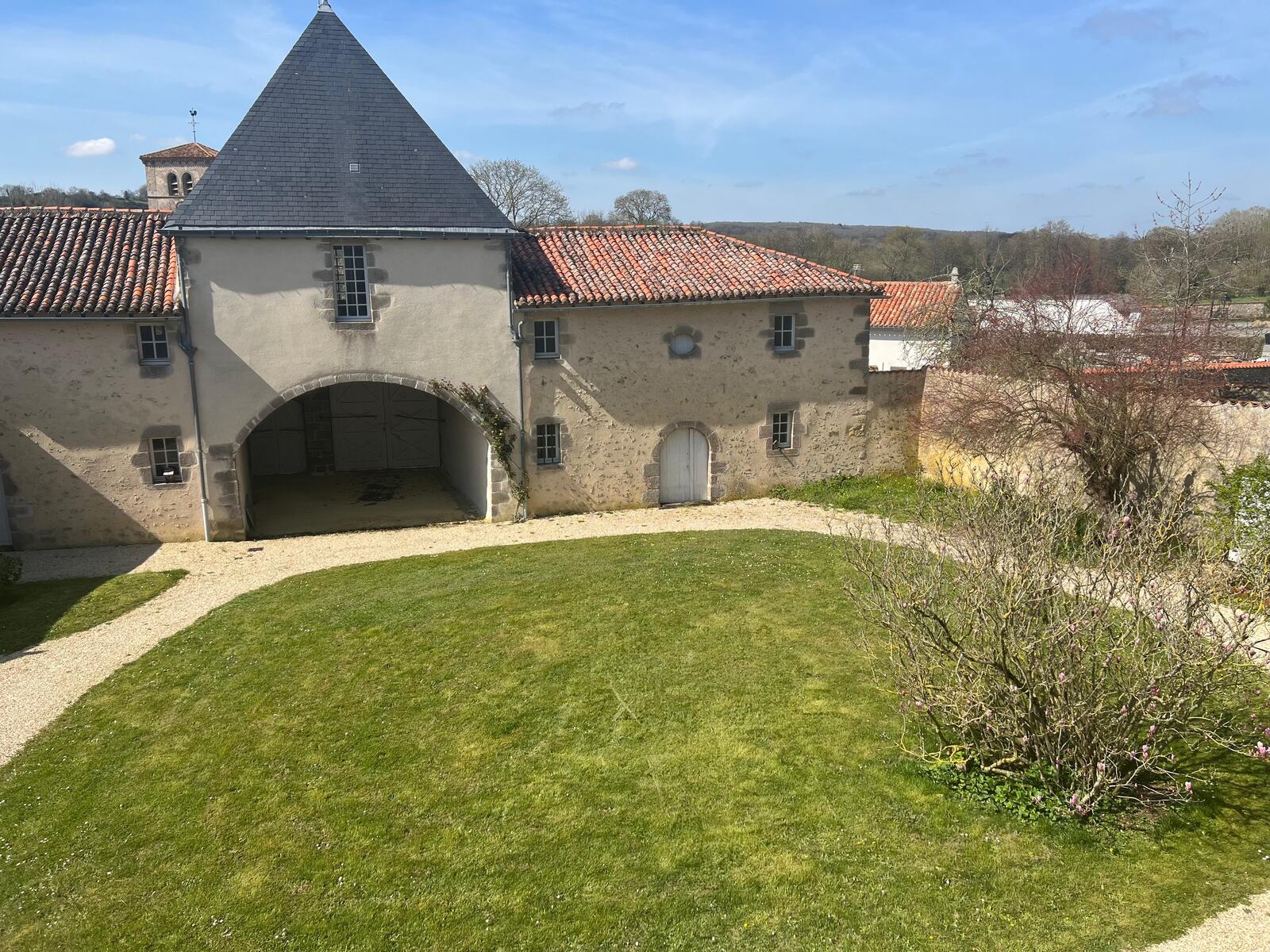
The priory of Saint-Jouin dates back to the 11th century. It belonged to the Benedictines and answered to the powerful Abbey of Saint-Jouin-de-Marnes. First established beside the church, it was rebuilt in the 15th century a few steps away, after a quarrel between the monks and the secular clergy. The present house was built on that site at the end of the 16th century.
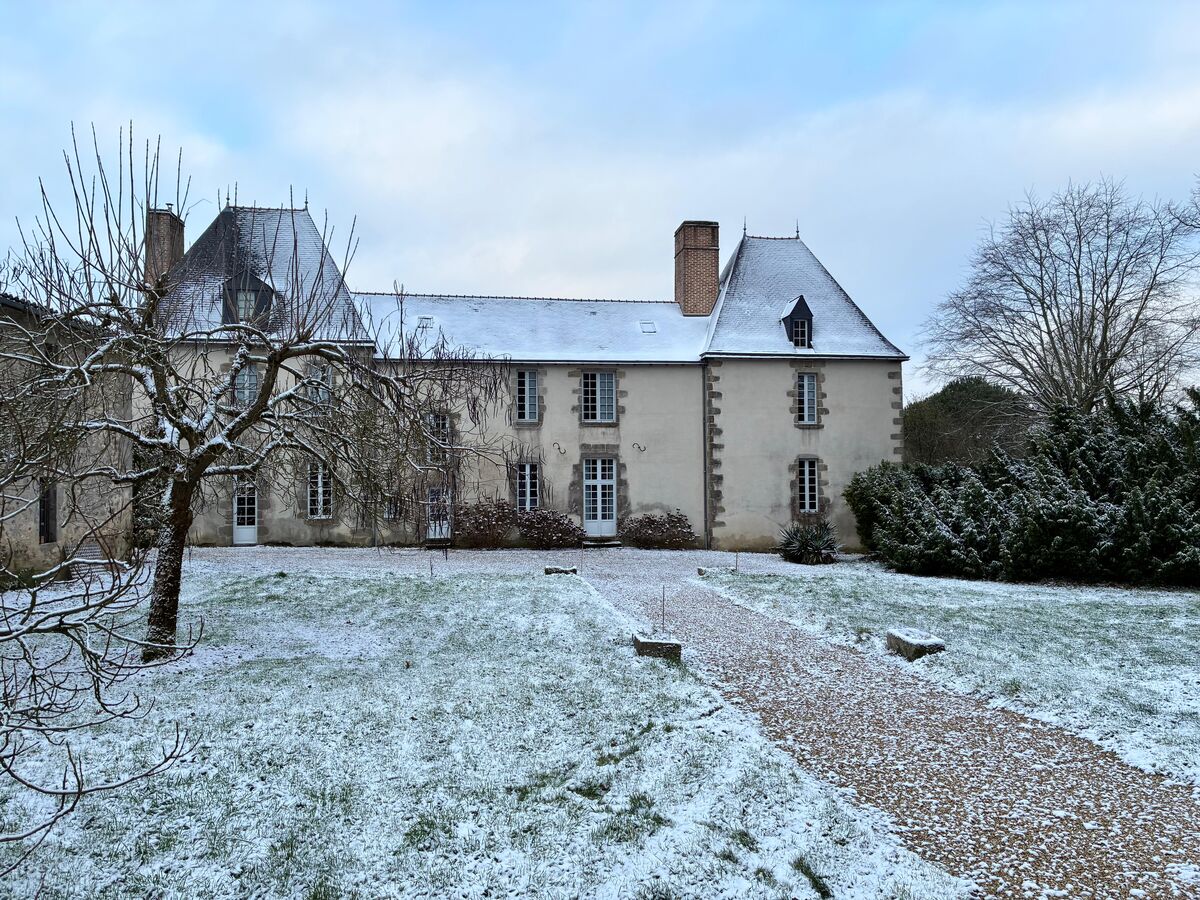
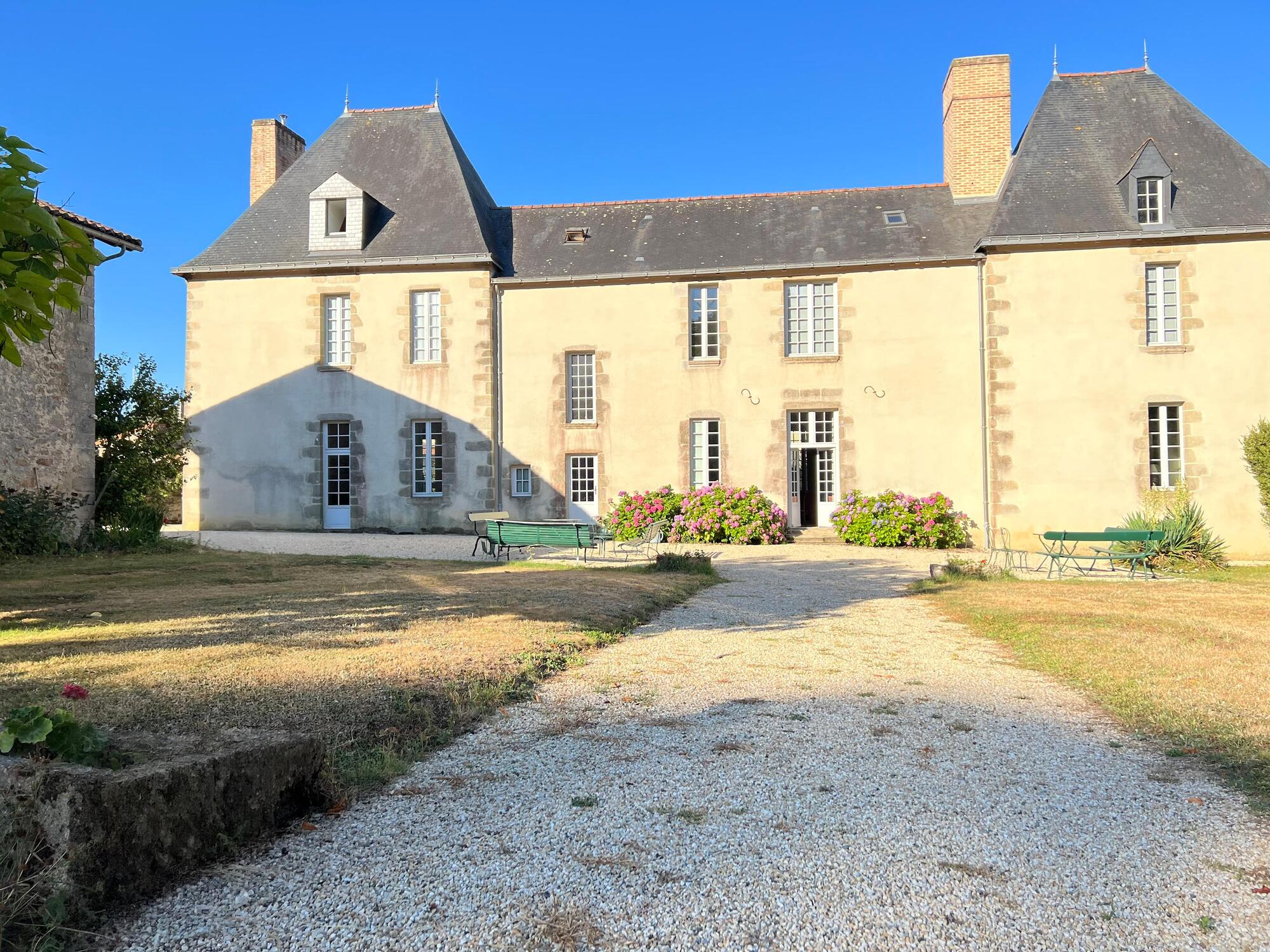
The Historic Monuments record describes it in a single sentence: a rectangular central building, flanked by two square pavilions, behind a vaulted gatehouse. It is still exactly what you see today.
Several priors served here: Gabriel de Beauregard in the 16th century, Claude Picot and François Bazin in the 17th, Hervé Ménard, Martial Poislève and Chauvelin in the 18th.
1793
At the heart of the Vendée wars
In 1793 the Bocage rose against the Revolution. Châtillon-sur-Sèvre, the neighbouring town, now Mauléon, hosted the Conseil supérieur, a kind of civil government of the insurgents. The war returned again and again: "on four occasions," Louis Fruchard would write, "the Vendée wars reached Châtillon-sur-Sèvre, now Mauléon, or its immediate surroundings."
The priory came through the turmoil unharmed. On 9 October 1793, the cannonballs exchanged between Republicans and Vendeans flew over the house without touching it.
The Fruchards, for their part, paid in blood. One Louis Fruchard, mayor of Vairé, was arrested in April 1793 "as a supplier and agent of the rebels" and guillotined on 18 April; he left, a chronicler of the time wrote, "a wife and eleven children". His sister Marie Jeanne was arrested in turn, "as an agent and supplier of the brigands". In 1794 another Fruchard, Catherine-Modeste, an Ursuline nun, was sent as a suspect to Noirmoutier and locked up in the island's castle. All trace of her is then lost.
Le Puy du Fou tells this story twenty minutes from here. At Saint-Jouin, you sleep where it actually happened, in the house of a family who lived through it.
From 1832 to 1897
A family house
The former priory became private property in 1832 and came into our family in 1841. It has never left it since.
In 1834, Pierre-Désiré Fruchard, a twenty-one-year-old medical student, married a local girl in Châtillon and settled as a country doctor, first in Châtillon, then in Saint-Jouin. He died there in 1897, aged eighty-four. He was Louis Fruchard's great-grandfather, and with him began a family of doctors.
Over the generations the house evolved: the outbuildings to the north were pulled down, a short wing was added to the south, new windows were opened to the south and east. A turret was even planned, but never built.
From 1873 to 1970
The inventor of the family
Between the country doctor and the doctor of Saint-Jouin, there was an engineer. Gaston Fruchard, Louis's father, was born in 1873, graduated from the École centrale and became a spring manufacturer, in Paris and then at his factory in Brionne, in Normandy.
He had an inventive mind. In 1912 he patented a device that warned of a deflating tyre by comparing the speed of the wheels: some of today's cars still detect flat tyres on the same principle. In 1937, at sixty-three, he designed a gearbox that adjusted itself. He filed a last patent at seventy-six, published at seventy-eight a short treatise, Les Logarithmes du ressort à boudin, and late in life took up a passion for mushrooms.
His parents ended their days at Saint-Jouin: his father in 1918, his mother, a painter shown at the Salon, in 1933. He himself died in Mauléon in 1970, aged ninety-seven.
"My family has lived in Saint-Jouin for four generations."
Louis Fruchard, in 1962
From 1947 to 1986
The doctor of Saint-Jouin
Louis Fruchard was born in Paris in 1921. Trained in the Paris hospitals, he defended his medical thesis in January 1947 and, rather than staying in the capital, settled as a general practitioner in Saint-Jouin-sous-Châtillon, the land of his forebears. Half a century after his great-grandfather's death, a Fruchard was once again caring for Saint-Jouin.
The 1949 medical directory sums him up in three lines: Saint-Jouin, 1,097 inhabitants, a single doctor; surgery from 1 to 3 pm, except Thursdays; telephone "Châtillon 70".
He practised for nearly forty years. In 1970, at a time when country doctors still mostly worked alone, he had a group medical and dental practice built on the Grand'Rue in Mauléon. His son would become a doctor in turn.
From 1959 to 1989
The mayor who gave Mauléon back its name
The doctor became mayor of Saint-Jouin in 1959. On 15 February 1965, at the request of the two mayors, both doctors, Saint-Jouin and Châtillon-sur-Sèvre merged and took back the name of Mauléon, which the town had lost in 1736. Louis Fruchard became its first mayor and remained so for twenty-four years: "the mayor of the change of name", as the Revue du Souvenir vendéen would call him.
A member of the departmental council from 1964 to 1988, he signed the twinning of Mauléon with Kirkel, in the Saarland, in 1980, and from 1986 to 1988 presided over the regional council of Poitou-Charentes, without leaving his town hall.
"We cannot dance on corpses."
Louis Fruchard, in 1988
1988
Refusing the Bicentenary
As 1989 approached, France was preparing to celebrate the bicentenary of the Revolution. A journalist asked the mayor of Mauléon whether his town would take part. "I confess I recoiled," he wrote in the town bulletin. "A land utterly destroyed and ravaged, almost the entire population massacred in Châtillon and in the neighbouring villages too."
As president of the Poitou-Charentes region, he became one of the voices of the Vendée's refusal. Le Monde picked up his words, La Stampa quoted them in Italian, the Los Angeles Times reported his anger. In the memory of his successor at the head of the region, Jean-Pierre Raffarin, they became: "We do not dance on our dead!"
He promised that 1993, two centuries after the uprising, would be commemorated "with dignity and gravity". Then he left political life: in 1989 he stepped down from the town hall of Mauléon, which he had held for twenty-four years.
From 1989 to 2006
The historian of the house
The doctor then turned historian: the Bicentenary had deeply shocked him, and he did not want the young to forget the Vendée tradition. In 1992 he published Les Quatre Guerres à Châtillon-sur-Sèvre, capitale de la Vendée militaire, the fruit of three years of research, signed from Saint-Jouin. At the head of the book he placed the motto of Quebec: "Je me souviens", I remember. In 1994 the Académie française awarded it the Georges-Goyau prize.
In the meantime, the promise of 1988 was kept. On 22 August 1993, before more than four hundred people, a granite cross eight and a half metres high, marked 1793-1993 and bearing a Vendée heart, was blessed in Mauléon. The former mayor introduced the speeches.
In 1996 he applied the same method to his own house: he compiled a History of the priory of Saint-Jouin or Grand Logis, ten pages of notes and copies of old documents, now kept in the departmental archives of the Deux-Sèvres.
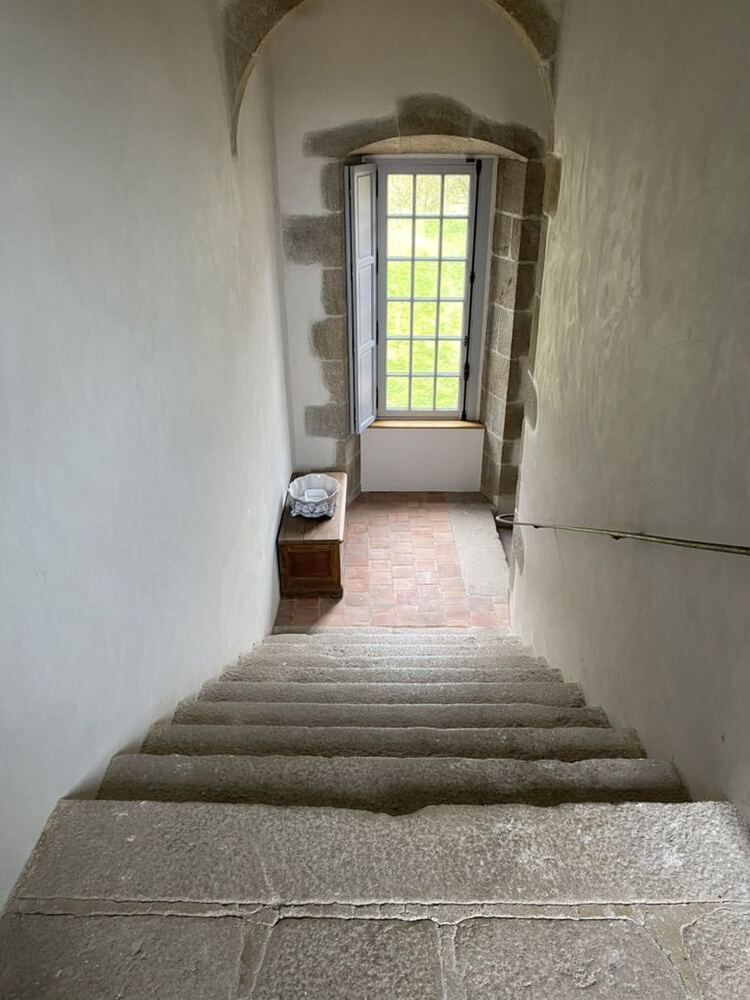
Louis Fruchard died in 2004; his funeral was held in the church of Saint-Jouin, a few steps from the house. On 17 July 2006, the house he had studied was listed as a Historic Monument, for its façades, its roofs and its staircase.
"Nothing is more alive than a memory."
Federico García Lorca, quoted by Louis Fruchard at the close of his book
A house to share
It is still a family house. Today we open it, for the length of a stay, to those who wish to gather their loved ones: eleven bedrooms, two walled hectares, a pool, a tennis court, and Le Puy du Fou twenty minutes away.
Make an enquiry